
If you have spotted a cockroach in your Singapore home or business, your first instinct is probably to want it gone fast. But before you reach for a spray can, there is one question worth answering: which species are you dealing with?
The German cockroach and the American cockroach are the two most commonly encountered cockroach species in Singapore, and they behave very differently. They prefer different habitats, breed at different rates, respond to different treatments, and pose different levels of difficulty for control. Treating the wrong species in the wrong way is one of the most common reasons cockroach infestations persist despite repeated DIY attempts.
In this guide, we break down everything you need to know about both species, how to tell them apart, where to find them, what signs to look for, and what actually works when it comes to getting rid of them for good.
At a Glance: German Cockroach vs American Cockroach – Key Differences
The table below summarises the most important differences between the two species at a glance. Detailed explanations for each characteristic follow in the sections below.
Feature | German Cockroach | American Cockroach |
|---|---|---|
Size | 13–16 mm (small) | 35–53 mm (large) |
Colour | Light brown/tan with two dark stripes behind the head | Reddish-brown with a pale yellow band on the thorax |
Wings | Has wings but rarely flies | Has wings and can fly short distances |
Lifespan | Approximately 200 days | Up to 700 days (nearly 2 years) |
Reproduction Rate | Very high – up to 400 offspring per female lifetime | Moderate – around 150 offspring per female lifetime |
Preferred Habitat | Kitchens, food prep areas, cracks near warmth & moisture | Drains, sewers, basements, service ducts, damp areas |
Active Period | Year-round indoors | Year-round; more active in warmer months |
Flight Behaviour | Rarely flies – prefers to run | Capable of short flight when startled or in heat |
DIY Treatment Difficulty | Very difficult – resistant to many chemicals | Moderate – more responsive to standard treatments |
Infestation Speed | Rapid – can infest a kitchen within weeks | Slower – but colonies can become very large over time |
Most Common In SG? | Yes – the most common indoor cockroach species | Yes – common in older buildings, drains, and commercial premises |
Identifying the German Cockroach in Singapore
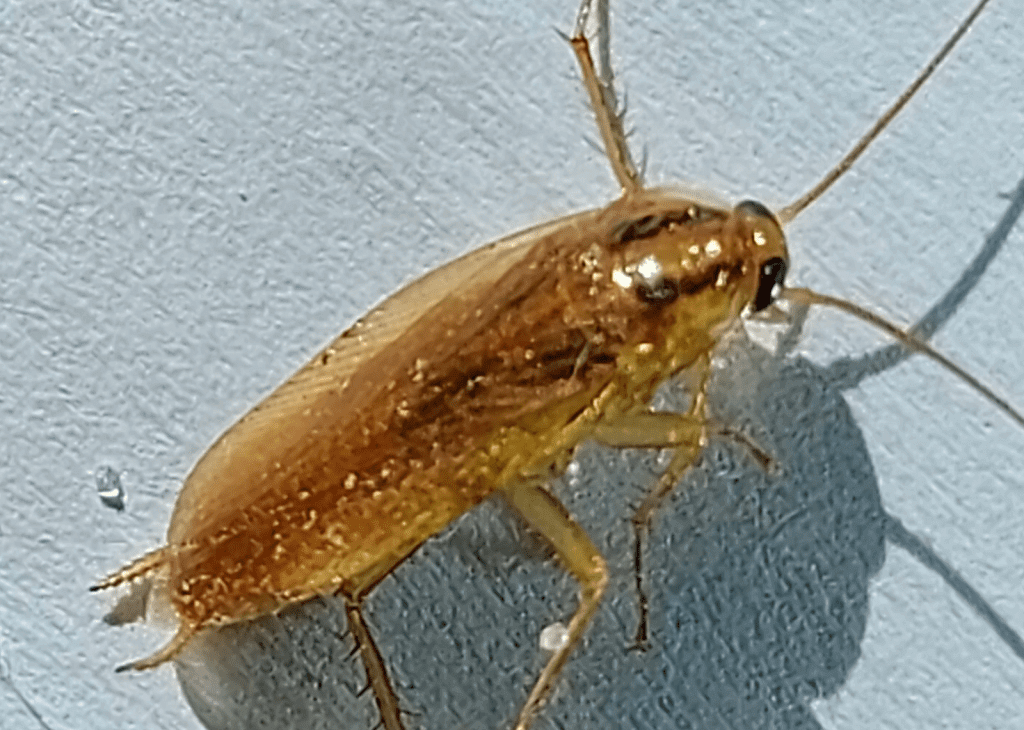
What Does a German Cockroach Look Like?
The German cockroach (Blattella germanica) is small, typically between 13 and 16 mm in length, roughly the size of a large paperclip. It is light brown to tan in colour, with two distinctive dark, parallel stripes running lengthwise behind its head on the pronotum (the shield-like plate just behind the head).
Despite having wings, German cockroaches almost never fly. They are fast runners and tend to scatter rapidly when disturbed, which is why spotting one during the day when cockroaches are naturally nocturnal is a reliable sign of a serious, overcrowded infestation.
Where Are German Cockroaches Found in Singapore?
German cockroaches are the most common indoor cockroach species in Singapore and are found almost exclusively inside buildings. They thrive in warm, humid environments close to food and water, which is why they are so strongly associated with kitchens and food handling areas.
Common harbouring areas include:
- Behind and underneath refrigerators, stoves, and dishwashers
- Inside kitchen cabinet hinges, cracks, and crevices
- Under sinks and around leaking pipe joints
- Inside electrical appliances such as microwaves and toasters, where warmth collects
- Behind loose tiles, skirting boards, and wall panels in bathrooms
- Inside restaurant food storage areas, point-of-sale equipment, and food display units
Why the German Cockroach Is the Harder Species to Eliminate
German cockroaches breed at an extraordinary rate. A single fertilised female can produce an egg case (ootheca) containing 30 to 40 eggs approximately every three to four weeks. In ideal conditions, which a Singapore kitchen provides in abundance, a population can grow from a handful of insects to hundreds within a single month.
Compounding this is the fact that German cockroaches have developed significant resistance to many of the insecticides found in over-the-counter sprays. Surface sprays kill the cockroaches they contact directly, but they do not penetrate the deep harbouring areas where the majority of the colony and the breeding females are located. This is why most DIY attempts against German cockroaches fail: the visible population is reduced temporarily, but the colony recovers quickly.
German cockroaches are considered the most difficult cockroach species to eradicate in Singapore without professional-grade gel baiting. Over-the-counter sprays are rarely sufficient for an established infestation. |
Identifying the American Cockroach in Singapore
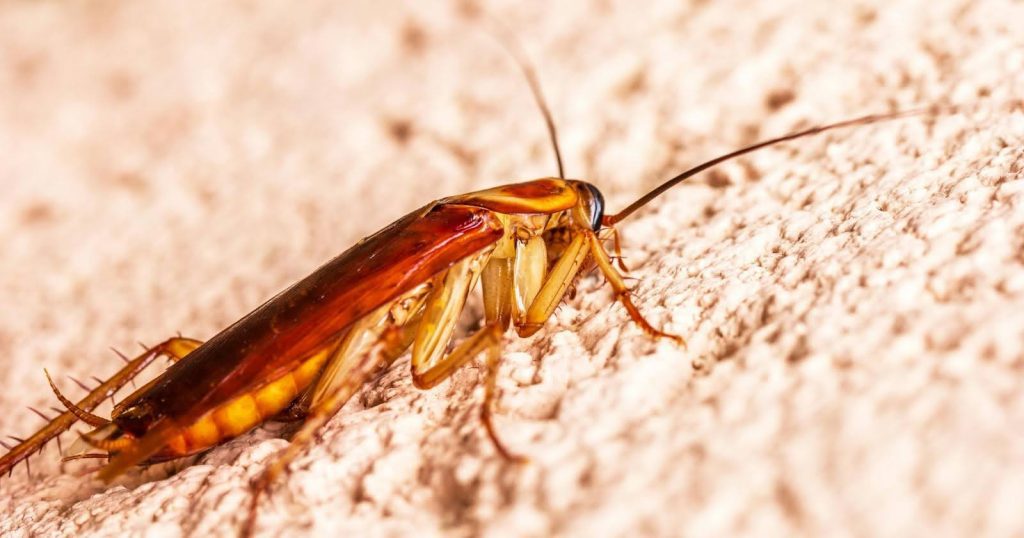
What Does an American Cockroach Look Like?
The American cockroach (Periplaneta americana) is considerably larger than the German cockroach, adults typically measure between 35 and 53 mm in length, making them one of the largest cockroach species encountered in Singapore homes. They are reddish-brown in colour, with a distinctive pale yellow or light-coloured figure-eight pattern on the back of the head.
Unlike the German cockroach, American cockroaches are fully capable of flight and will occasionally take short flights when startled or when temperatures are high. Spotting a large, reddish-brown cockroach flying across a room at night is almost always an American cockroach.
Where Are American Cockroaches Found in Singapore?
American cockroaches prefer damper, less disturbed environments than German cockroaches. In Singapore, they are commonly found in:
- Floor drains, sewage pipes, and drainage channels this is their primary habitat and entry route into buildings
- Basements, underground carparks, and service tunnels
- Rubbish chutes and bin centres in HDB blocks and condominiums
- Outdoor landscaping areas, tree hollows, and garden mulch
- Older residential buildings with aging drainage infrastructure
- Commercial kitchens and warehouses where large floor drains are present
American cockroaches typically enter homes and commercial premises from outside migrating up through drains, into gaps under doors, and through gaps around pipework. This is an important distinction from the German cockroach, which is almost always introduced through infested products (cardboard boxes, second-hand appliances, food deliveries) rather than entering from the environment.
How Dangerous Is the American Cockroach?
Both species are capable of spreading bacteria, pathogens, and allergens, but the American cockroach’s preference for sewers and drains means it carries a particularly high bacterial load. Contamination of food preparation surfaces, utensils, or food products by American cockroaches can lead to foodborne illness. Their shed skins and droppings are also known to trigger asthma and allergic reactions, particularly in children.
In Singapore’s food and beverage sector, the presence of American cockroaches is a serious hygiene violation that can result in NEA enforcement action and temporary closure orders.
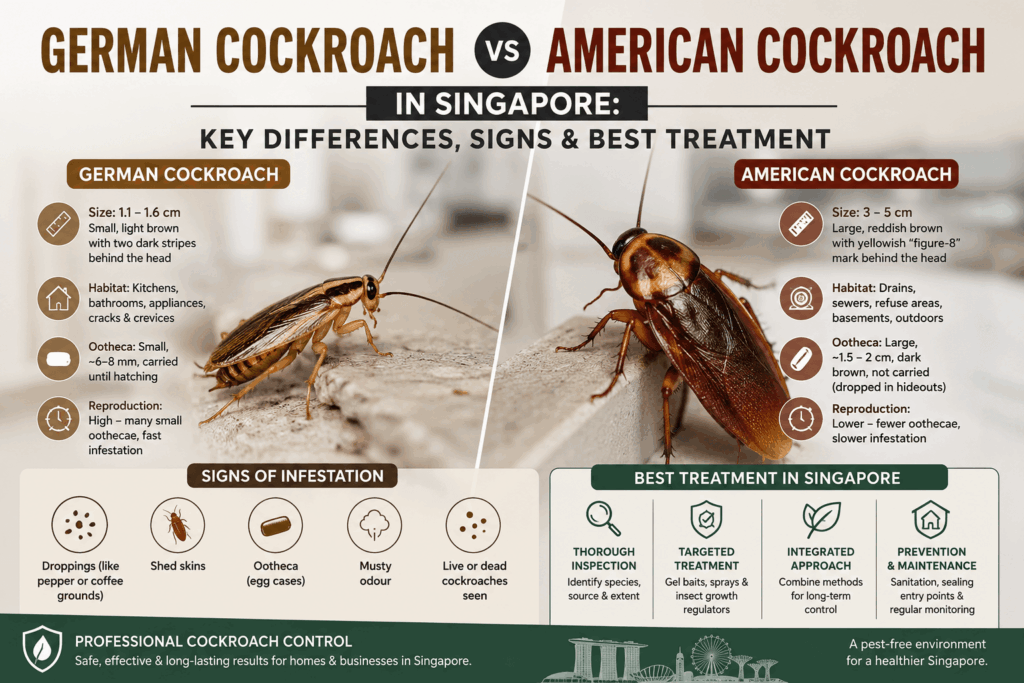
Signs of a Cockroach Infestation: German vs American
Signs Specific to German Cockroach Infestation
- Small, dark droppings resembling coffee grounds or black pepper, found in kitchen drawers, inside hinges, and under appliances
- Brownish smear marks on walls and surfaces near moisture sources
- Shed skins (nymphal casings) in concealed areas. German cockroach nymphs shed skin six to seven times before reaching adulthood
- A musty, oily odour in the kitchen is more pronounced in heavier infestations
- Egg cases (oothecae) found inside appliances, behind cabinets, or in crevices near food German cockroach oothecae are small, light brown capsules
- Cockroaches seen during the daytime are a sign of severe overcrowding, forcing individuals out of their hiding places
Signs Specific to American Cockroach Infestation
- Large, cylindrical droppings with ridged edges. American cockroach droppings are noticeably bigger than German cockroach droppings and may be mistaken for mouse droppings
- A strong, musty odour near drains, rubbish areas, or basements
- Large cockroaches seen near floor drains, in toilets, or emerging from under doors at night
- Cockroaches seen outdoors in garden areas or near bin collections, particularly after dark
- Evidence of gnawing on food packaging, leather, or paper materials in storage areas
- Egg cases found near drains, in basements, or in moist, sheltered outdoor locations American cockroach oothecae are dark brown and approximately 8 mm in length
Best Treatment for German Cockroaches in Singapore
Because of their resistance to standard chemical sprays and their ability to breed rapidly in concealed locations, German cockroaches require a targeted, professional approach.
Gel Baiting – The Most Effective Method
Gel baiting is the gold standard for German cockroach control in Singapore, particularly in kitchens and food handling environments. Small dots of bait gel are placed precisely in the harbouring areas where cockroaches live inside hinges, behind appliances, in cracks near plumbing. Worker cockroaches consume the bait and carry the active ingredient back to the colony, where it spreads to other individuals including the queen.
Unlike surface spraying, gel baiting does not require the cockroach to walk through a treated surface; it works by exploiting the cockroach’s natural feeding and social behaviour. This makes it far more effective at reaching the breeding females hidden deep within the infestation.
Why Surface Sprays Are Not Enough
For German cockroaches, residual insecticide sprays should be used as a complement to gel baiting rather than a standalone solution. Sprays treat exposed surfaces but do not penetrate the wall cavities, appliance internals, and deep crevices where the colony is concentrated. Relying on surface sprays alone often pushes cockroaches deeper into the structure, making the infestation harder to detect and treat on subsequent visits.
Monitoring and Follow-Up
Professional German cockroach treatment typically involves a minimum of two visits spaced two to three weeks apart. The first visit addresses the primary harbouring areas and applies bait. The second visit assesses bait consumption, identifies any new hotspots, and applies booster treatments where required. In severe infestations particularly in commercial food premises, three or more visits may be necessary.
Best Treatment for American Cockroaches in Singapore
American cockroaches are generally more responsive to conventional insecticide treatments than German cockroaches, but their preferred harbouring areas – drains, sewers, and outdoor environments – require a different approach.
Drain Treatment and Entry Point Management
Because American cockroaches most commonly enter buildings through drainage systems, addressing the entry routes is essential. Professional treatment includes applying insecticide directly to drain openings, service ducts, and pipework access points to create a chemical barrier. Physical exclusion measures such as fitting drain covers and sealing gaps around pipes are recommended alongside chemical treatment.
Residual Spraying for Indoor Infestations
For American cockroaches found inside buildings, residual insecticide spraying along skirting boards, behind appliances, and in basement areas is effective. The spray leaves a residual film on treated surfaces that kills cockroaches as they pass over it, typically remaining active for four to eight weeks.
ULV Fogging for Large Spaces
In large commercial or industrial settings warehouses, food processing facilities, and restaurant kitchens with extensive floor drainage ULV (Ultra Low Volume) fogging complements residual treatment by reaching ceiling voids, wall cavities, and drainage infrastructure that surface sprays cannot access. ULV fogging is not recommended as a standalone treatment and is most effective when used as part of an integrated pest management programme.
Treatment Method Comparison
Treatment Method | Best For | Notes |
|---|---|---|
Gel Baiting | German cockroach – all settings | Highly effective. Worker ants carry bait back to colony. Preferred method for food establishments. |
Residual Spraying | American cockroach – indoor harbourage areas | Applied to surfaces where cockroaches rest and travel. Lasts 4–8 weeks depending on conditions. |
ULV Fogging | Large commercial or industrial spaces | Reaches wall cavities and false ceilings. Not suitable as a standalone solution use alongside baiting. |
Cockroach Dusting | Wall cavities, voids, drainage access points | Insecticidal dust settles in harbourage zones. Long-lasting residual effect. |
Drain Treatment | American cockroach entering via drainage | Targeted application at drain entry points to block the primary access route. |
Integrated Programme | Severe or recurring infestations (both species) | Combines baiting, spraying, dusting, and monitoring across multiple visits for full colony elimination. |
Can You Have Both Species at the Same Time?
Yes, and it is more common than most people realise, particularly in older HDB blocks, shophouses, and food and beverage establishments. It is entirely possible to have a German cockroach infestation in the kitchen and an American cockroach problem entering via the bathroom or kitchen drains simultaneously.
This is one of the key reasons why professional inspection is so valuable. A trained technician can identify the species present, assess each infestation independently, and design a treatment plan that addresses both using gel baiting for the German cockroaches in harbouring areas alongside drain treatment and residual spraying for the American cockroaches entering via drainage.
Treating only one species while ignoring the other is a common cause of persistent cockroach problems that homeowners and business owners assume are simply ‘resistant’ to treatment.
Prevention Tips for Both Species
Preventing German Cockroach Infestations
- Inspect all cardboard boxes, grocery deliveries, and second-hand appliances before bringing them into your home or business, German cockroaches most commonly spread via infested packaging and goods.
- Seal all cracks and crevices in kitchen cabinets, around pipework, and in tiled surfaces using silicone sealant.
- Fix all water leaks promptly – German cockroaches require moisture to thrive, and a dripping pipe under a sink is an ideal harbouring environment.
- Store all food in airtight containers and remove food waste daily do not leave dirty dishes in the sink overnight.
- Clean behind and underneath heavy appliances (refrigerators, cookers, dishwashers) regularly grease and food debris accumulation create ideal feeding and nesting conditions.
Preventing American Cockroach Infestations
- Install tight-fitting drain covers on all floor drains, particularly in bathrooms, kitchens, and service areas this is the single most effective preventive measure against American cockroaches.
- Seal all gaps around pipework entry points where pipes pass through walls or floors.
- Ensure all exterior doors have well-fitted door sweeps that close flush to the floor with no gaps.
- Keep outdoor areas, garden beds, and bin centres clean and free of decaying organic material, which American cockroaches use as a food source and harbouring area.
- In older buildings, have your drainage infrastructure inspected periodically for cracks and gaps that may allow cockroach access.
When to Call a Professional Pest Control Company
If you are seeing cockroaches regularly, particularly during daytime or if you have attempted DIY treatment without lasting results, the infestation is almost certainly more established than what is visible. Cockroaches spend approximately 75% of their lives in hiding, meaning the insects you see represent only a fraction of the colony’s actual size.
A professional pest control company will conduct a thorough inspection to confirm the species, map the extent of the infestation, and apply a targeted treatment plan using NEA-approved chemicals and methods. For German cockroach infestations, especially professional-grade gel baiting is the most reliable route to full elimination.
Frequently Asked Questions
Both species carry bacteria and allergens that can be harmful to health, but neither is inherently ‘more dangerous’ in absolute terms. The German cockroach poses a greater risk in food handling environments due to its preference for kitchens and food contact surfaces, and its rapid reproduction rate means infestations can reach serious levels quickly. The American cockroach, migrating from sewers and drains, carries a high bacterial load from its environment. In both cases, prompt professional treatment is the recommended response.
A large cockroach, 35 mm or longer, reddish-brown, capable of flight, is almost certainly an American cockroach. They are commonly seen at night, particularly during warmer months, and tend to fly when startled or when seeking a food source. If you are seeing them regularly, check your floor drains and any gaps around pipework entering the property, as these are the most common entry routes.
This is the most common complaint associated with German cockroach infestations. Surface sprays kill the cockroaches that walk through the treated area, but the breeding females and the majority of the colony are concealed deep in crevices, appliance interiors, and wall cavities where the spray does not reach. The population recovers between treatments. Professional gel baiting, which works by having cockroaches carry the active ingredient back to the colony, is far more effective at resolving established German cockroach infestations.
American cockroaches are strong swimmers and are fully capable of travelling through drainage pipes and emerging through floor drains, toilet bowls, and sink drains particularly when drainage traps are dry or poorly fitted. This is more common in older buildings with aging drainage infrastructure. Keeping drain covers fitted and ensuring P-traps in floor drains remain filled with water (preventing sewer gas and pest entry) is the most effective preventive measure.
After professional treatment, you should see a significant reduction in cockroach sightings within 48 to 72 hours for American cockroaches (which respond quickly to residual spraying) and within one to two weeks for German cockroaches treated with gel baiting (as the bait needs time to be carried through the colony). A professional follow-up visit typically scheduled two to three weeks after the initial treatment will confirm whether the infestation has been fully resolved or whether booster treatments are required.
For a minor American cockroach sighting (one or two individuals entering from outside), a single treatment combined with exclusion measures at the entry points is often sufficient. For an established German cockroach infestation, a minimum of two visits is typically required and for severe infestations in commercial premises, three or more visits are standard. Your pest control technician will advise on the recommended programme after the on-site inspection.
All treatments carried out by Conquer Pest use only NEA-approved chemicals. When applied correctly by a trained professional, these products are safe for residential use. We advise residents to vacate treated areas for one to two hours following treatment and to avoid contact with treated surfaces until they have dried. Food preparation surfaces should be wiped down before use. Your technician will provide specific safety advice tailored to your household on the day of treatment.