Warehouses and logistics facilities are among the most challenging environments to manage from a pest control perspective. Large footprints, constant movement of goods, high-density racking, loading bay exposure, and the persistent presence of packaging materials create ideal conditions for pests to establish and spread, often without detection until the problem is well advanced.
In Singapore, where humidity and heat are constant, where food-grade and pharmaceutical logistics operations face strict regulatory requirements, and where proximity to industrial estates with shared pest pressure is common, a reactive approach to warehouse pest control is simply not viable.
This guide is written for warehouse managers, logistics operations managers, and facilities teams who need to understand what professional pest control looks like in a large commercial environment and what it takes to keep it effective.
Why Warehouses Face a Higher Pest Risk Than Most Commercial Premises
The very features that make a warehouse functional also make it attractive to pests. Understanding these risk factors is the first step to managing them properly.
Inbound goods and packaging. Every delivery entering a warehouse is a potential pest vector. Cardboard, pallets, timber crating, bulk sacks, and imported goods can carry cockroach egg cases, rodents, stored-product insects, and other hitchhiker pests that pass right through your loading bay and into racking. A single contaminated pallet can introduce an infestation that takes months to fully clear.
Loading bays and dock levellers. Loading bays are permanently high-risk entry points. Roller doors that don’t seal flush to the floor, dock leveller gaps, and open bay doors during receiving hours give rodents, cockroaches, and flies continuous access. The area immediately around loading bays tends to accumulate organic debris spilled product, packaging scraps, and pooled water, which compounds the problem.
High-bay racking and inaccessible voids. Pests are very good at exploiting the areas humans don’t regularly access. High-bay racking creates microclimates at height, sheltered, warm, and rarely disturbed. Cockroaches and rodents can establish colonies in upper rack levels that go undetected for extended periods. Mezzanine floors, cable trays, and roof voids offer additional harbourage.
Packaging materials and dunnage storage. Stacked pallets, flat cardboard, and bulk packaging materials stored on the warehouse floor create exactly the layered, sheltered environment that cockroaches and rodents seek. These areas are often cleaned irregularly and treated as low-priority, which is precisely why they’re common infestation hotspots.
Food-grade, FMCG, and pharmaceutical cargo. Warehouses handling food products, consumer goods, or pharmaceutical stock face additional risk because the cargo itself is a food source. Stored-product insects including grain beetles, flour moths, and weevils, can infest product on the shelf without any obvious external signs until packaging is opened.
Outdoor perimeter exposure. Industrial estates in Singapore often include landscaped areas, drains, and open ground that harbour rodent populations. A warehouse sitting next to scrubland, a canal, or a high-density industrial neighbour faces constant reinfestation pressure from the perimeter regardless of internal hygiene.
The Most Common Pests in Singapore Warehouses
Rodents (Rats and Mice)
Rodents are the highest-priority pest risk in most warehouse environments. The consequences of rodent activity go beyond the physical damage to contaminated stock, gnawed wiring, and structural damage to include serious regulatory and financial implications for food-grade and pharmaceutical operations.
In Singapore’s warehouse environments, the Norway rat (Rattus norvegicus) and the roof rat (Rattus rattus) are both common. Norway rats favour ground-level burrows near loading bays and perimeter walls. Roof rats are agile climbers and frequently found in roof voids, mezzanines, and upper racking often discovered only when gnaw damage or droppings are found at height.
Rodent presence in a warehouse can result in product recall, customer complaints, and regulatory action for food-grade operators. It should be treated as a zero-tolerance issue.
Cockroaches
American cockroaches (Periplaneta americana) are common in large warehouse spaces particularly near drainage infrastructure, waste compactors, and any area where moisture accumulates. German cockroaches appear where food is available, including warehouses handling food products, staff canteens, and break rooms within the facility.
Cockroach activity in racking areas is often detected through frass (droppings), cast skins, or egg cases found during routine inspection rather than from live sightings underscoring the importance of structured monitoring.
Stored-Product Insects
Grain beetles, cigarette beetles, flour moths, weevils, and related stored-product insects are a major concern for warehouses handling food commodities, agricultural products, or any organic-based goods. These pests can infest product within sealed packaging if packaging integrity is compromised, and their presence often isn’t identified until product is at the retail stage.
Stored-product insect management requires a different approach from standard cockroach or rodent control including product inspection protocols, temperature management, and targeted pheromone trapping.
Flies
Flies in warehouse environments typically indicate a nearby organic waste source a waste compactor that isn’t being managed effectively, a blocked floor drain, or decomposing product somewhere in the facility. Blow flies, houseflies, and drain flies each signal different root causes and require different responses.
For food-grade and pharmaceutical warehouses, fly presence near packing and dispatch areas is a direct compliance risk.
Ants
Ants in warehouses are common but often underestimated. Fire ants and large-headed ants in particular can cause real product contamination risk in food-handling environments. Ant activity in warehouse racking is frequently linked to product spillage or damaged packaging that hasn’t been identified and cleaned.

Regulatory and Compliance Context for Singapore Warehouses
Pest control in warehouse environments isn’t just an operational concern it has direct regulatory implications for several categories of business.
AVS (Singapore Food Agency) licensed food warehouses are subject to inspection and must demonstrate adequate pest control management, including documentation of treatments. A pest sighting during an audit can result in immediate corrective action requirements.
GMP-compliant warehouses (pharmaceutical, cosmetics, regulated medical devices) are typically required to maintain documented pest control programmes as part of their quality management systems, with records available for customer or regulatory audit.
HACCP-certified operations require a documented pest management programme as a prerequisite programme, with regular monitoring records as evidence of control.
Third-party logistics (3PL) operators often face customer-mandated pest control standards, particularly from multinational FMCG and pharmaceutical clients who conduct regular supplier audits.
Even for warehouses without specific regulatory requirements, having documented pest control records significantly reduces liability exposure in the event of a product contamination claim.
What a Professional Warehouse Pest Control Programme Should Include
Comprehensive Site Assessment
A meaningful initial assessment of a warehouse goes well beyond a visual walk-through. It should cover: the building perimeter and surrounding environment, all loading bays and dock areas, drainage infrastructure, racking (including upper levels where accessible), storage of pallets and packaging materials, waste management areas, staff amenity areas, and any void spaces or mezzanine floors.
The assessment should produce a written report identifying: active pest activity, evidence of historical activity, high-risk zones, structural vulnerabilities, and a recommended treatment and monitoring plan.
Integrated Pest Management (IPM) Approach
For warehouses, an integrated approach is far more effective than chemical treatment alone. A proper IPM programme includes:
Monitoring: Bait stations and snap traps for rodents, placed at loading bays, along perimeter walls, and near high-risk internal zones. Insect monitoring traps (pheromone or light-based) for stored-product insects and flies. Regular inspection of monitoring devices with documented counts.
Physical exclusion: Sealing gaps at loading bays, installing door sweeps, fitting brush seals to roller doors, screening vents and drains. Exclusion is the most cost-effective long-term rodent control measure in warehouse environments.
Environmental management: Addressing the conditions that make the warehouse attractive to pests waste management practices, drainage maintenance, packaging storage organisation, and spill response procedures.
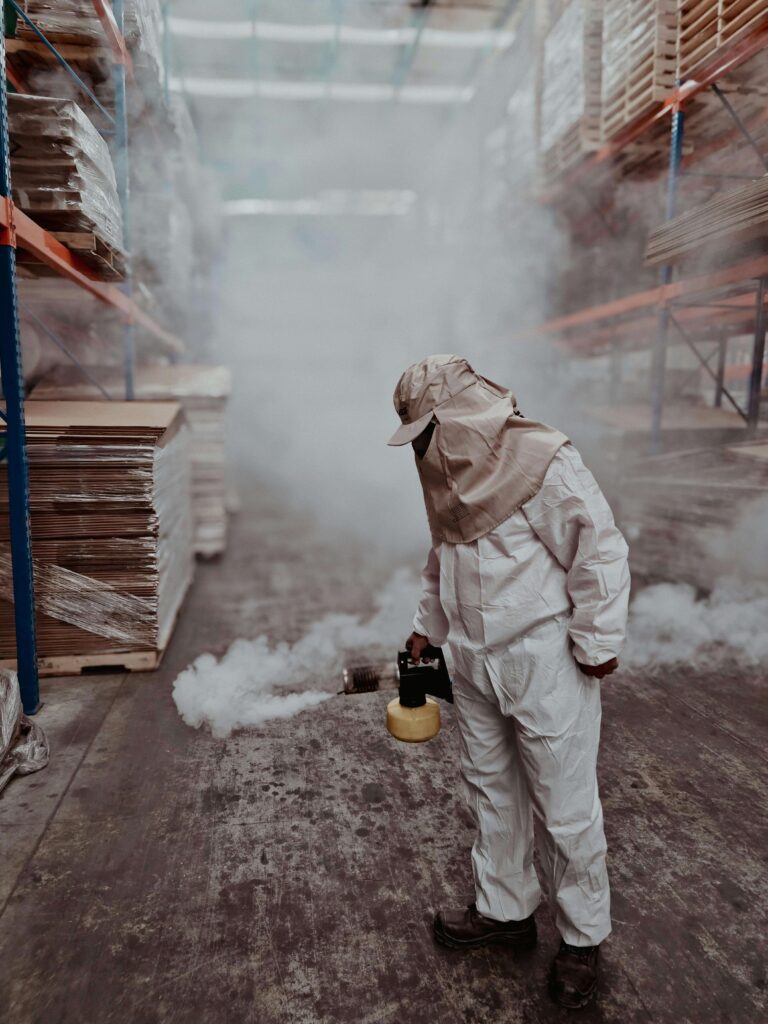
Chemical treatment: Targeted rodenticide in tamper-proof bait stations, residual insecticide for cockroaches in harbourage areas, and appropriate knockdown treatment where active infestations are identified. All chemical treatment should be documented with product names, application rates, and target areas.
Fumigation (where required): For warehouses handling food commodities or facing stored-product insect pressure, periodic fumigation may be required. This should be carried out by qualified operators with full documentation.
Regular Scheduled Visits
The appropriate visit frequency for a warehouse depends on size, cargo type, pest history, and regulatory requirements. Monthly visits are standard for food-grade and pharmaceutical operations. Bi-monthly may be appropriate for lower-risk general warehouses with no food-product exposure. High-risk operations (large food warehouses, pest history, direct external exposure) may require weekly monitoring.
At each visit, your pest control provider should inspect all monitoring devices, record activity levels, carry out any necessary treatment, and provide a written report.
Documentation and Audit Readiness
For regulated operations, documentation is as important as the treatment itself. Your pest control programme should produce:
- A site-specific pest control plan
- Records of all visits, treatments, and findings
- Monitoring device maps showing placement and activity records
- Corrective action records when pest activity is identified
- Annual review documentation
This documentation should be maintained in a format that can be presented to auditors, customers, or regulators on request.
Internal Procedures That Significantly Reduce Pest Pressure
Professional pest control manages the problem from the outside in. Internal procedures that your operations and warehouse team follow are equally important.
Inbound goods inspection. Designate a receiving area where inbound cargo is inspected before entering storage. Check pallets and outer packaging for signs of pest activity gnaw marks, droppings, frass, egg cases, or live insects before goods are placed in racking. Any suspect consignment should be quarantined and inspected properly before release.
Pallet and packaging management. Do not allow pallets, empty cardboard, or dunnage to accumulate on the warehouse floor. Pallets should be stored on designated racks off the floor. Cardboard should be broken down and removed promptly rather than stacked in corners.
Damaged goods protocol. Damaged or leaking stock is an immediate pest attractant. Implement a clear procedure for identifying, isolating, and disposing of damaged product promptly. Residue from spills liquids, powder, granules should be cleaned up immediately rather than left for the next shift.
Waste management. Waste compactors, bins, and waste staging areas are among the highest-risk zones in any warehouse. Bins should be covered and emptied regularly. The area around waste storage should be cleaned and kept dry. Compactors should be inspected and cleaned regularly the buildup inside a neglected compactor is a significant pest attractant.
Perimeter maintenance. The area immediately surrounding the warehouse exterior significantly affects pest pressure inside. Vegetation should be kept trimmed and away from building walls. Standing water in drains, puddles, or blocked gutters near the perimeter should be addressed promptly. Report and act on any burrow activity or signs of rodent movement around the perimeter.
Staff training. Warehouse staff are often the first to notice early signs of pest activity and one of the most effective parts of any prevention programme if properly informed. Train staff to recognise the signs of common pest activity (droppings, gnaw marks, unusual sounds, damaged packaging), know how to report sightings, and understand why hygiene and packaging practices directly affect pest risk.
Signs That Indicate a Developing Problem
Warehouses often operate with infrequent pest incidents for extended periods, which can create complacency. These are the signs that should trigger immediate action:
- Rodent droppings in racking, near loading bays, or in packaging storage
- Gnaw marks on wiring, packaging, or structural elements
- Live rodent sightings during day shift (a serious indicator of heavy infestation)
- Cockroach sightings in daytime near racking or packing areas
- Damaged product with no clear mechanical explanation
- Unusual insect activity around specific product lines or storage areas
- Persistent fly activity despite waste management improvements
- Unusual smells in enclosed storage areas (musty, ammonia-like)
Any of these signs should be escalated to your pest control provider immediately rather than waiting for the next scheduled visit.
Choosing a Pest Control Provider for Your Warehouse
A warehouse pest control programme requires a provider with genuine experience in large commercial and industrial environments. When evaluating providers:
Ask about warehouse-specific experience. Pest management in a 10,000 sqm warehouse is fundamentally different from a shophouse or office. Your provider should be able to describe specific warehouses they manage, the pest pressures involved, and how they approach large-footprint monitoring and treatment.
Verify NEA licensing. Confirm that the company and their operators hold valid NEA licences. For regulated operations, confirm that their documentation format meets your audit requirements.
Assess their IPM approach. Be cautious of providers who lead with chemical treatment as the primary solution. Effective warehouse pest management is built on monitoring, exclusion, and environmental management. Chemical treatment is one tool within a broader programme.
Review their reporting format. Ask to see a sample report. It should include monitoring device readings, treatment records, findings, and actionable recommendations not just a signature sheet.
Understand their escalation process. When active rodent infestation is detected or pest activity spikes unexpectedly, what is the response time? Does the programme include provisions for emergency call-outs?
Conclusion
Pest control in a warehouse or logistics facility isn’t a box-ticking exercise it’s a critical operational function with direct implications for product integrity, regulatory compliance, customer relationships, and staff welfare.
The conditions that define a functioning warehouse inbound goods, packaging, loading bay exposure, dense storage, and large accessible voids are exactly the conditions that make pest management complex. A structured, documented, integrated programme is the only approach that consistently delivers long-term control in Singapore’s environment.
If your warehouse is currently relying on reactive treatments, has experienced recurring rodent or cockroach activity, or needs to meet customer or regulatory audit requirements, a professional programme review is a practical starting point.
Conquer Pest provides commercial and industrial pest control services for warehouses, logistics facilities, and manufacturing plants across Singapore. We are NEA-certified and experienced in food-grade and pharmaceutical environments. Contact us for a free site assessment and programme proposal.